Choosing between OEM vs ODM manufacturing in China is one of the most important decisions for importers, Amazon sellers, startups, and established brands. The right model affects your product cost, development timeline, intellectual property protection, quality control, and long-term brand value.
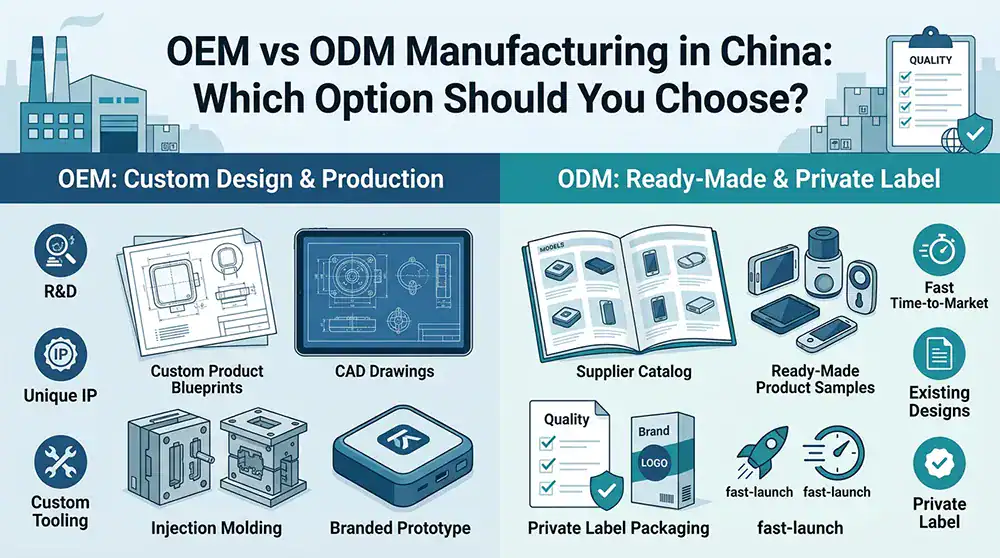
If you are planning OEM manufacturing in China, you usually provide the product design, specifications, drawings, materials, or technical requirements. If you choose ODM manufacturing in China, the supplier already has an existing design that you can customize, brand, and bring to market faster.
Both options can work well, but they serve different business goals. This guide explains the difference between OEM and ODM, the pros and cons of each, and how to decide which China manufacturing model is best for your product.

OEM vs ODM Manufacturing in China: What Do They Mean?
In China sourcing, OEM and ODM are both common forms of contract manufacturing. China’s State Administration for Market Regulation describes OEM as a model where the entrusted manufacturer produces according to the client’s formula, process, or technical materials and applies the client’s label. ODM uses the manufacturer’s own production technology or product design while applying the client’s trademark.
What Is OEM Manufacturing in China?
OEM manufacturing in China means “Original Equipment Manufacturing.” In simple terms, the buyer owns or controls the product concept, design, branding, specifications, and often the tooling.
The Chinese factory mainly acts as the production partner. They manufacture according to your requirements.
OEM is common for:
- Custom electronics
- Industrial parts
- Medical devices
- Automotive components
- Custom packaging
- Patented consumer products
- Products with unique dimensions, materials, or functions
With OEM, you usually need detailed product files, such as CAD drawings, bill of materials, technical specifications, approved samples, and testing requirements.
What Is ODM Manufacturing in China?
ODM manufacturing in China means “Original Design Manufacturing.” In this model, the factory already has an existing product design or semi-developed product. You can customize features, colors, packaging, logo, materials, accessories, or minor functions.
ODM is common for:
- Consumer electronics accessories
- Beauty devices
- Kitchenware
- Home goods
- Fitness products
- Pet products
- Promotional items
- Private label products
For many eCommerce sellers, ODM is faster and easier because the supplier already has experience producing the item.

OEM vs ODM Manufacturing in China: Key Differences
The biggest difference in OEM vs ODM manufacturing in China is ownership and control.
With OEM, you bring the design. With ODM, the supplier provides the base design.
| Factor | OEM Manufacturing in China | ODM Manufacturing in China |
|---|---|---|
| Product design | Buyer provides design | Supplier provides design |
| Customization | High | Medium to limited |
| Startup cost | Higher | Lower |
| Development time | Longer | Faster |
| IP ownership | Usually buyer-owned | Must be clarified |
| MOQ | Often higher | Often lower |
| Best for | Unique products | Fast private label launch |
| Risk level | Technical risk | Differentiation and IP risk |
If your product’s value comes from unique engineering, OEM may be the better choice. If your value comes from branding, packaging, marketing, and speed to market, ODM may be more practical.
OEM Manufacturing in China: Pros and Cons
Advantages of OEM Manufacturing in China
The main advantage of OEM manufacturing in China is control. You can define the product structure, performance, materials, functions, tolerances, and compliance requirements.
OEM is ideal when you want to build a defensible product that competitors cannot easily copy.
Key benefits include:
- More product differentiation
- Better control over specifications
- Stronger brand ownership
- Easier to create exclusive features
- More flexibility for long-term product improvement
- Better fit for patented or technically complex products
OEM also gives you more leverage when building a serious brand. If the supplier relationship is managed correctly, you are not simply selling the same catalog product as dozens of competitors.
Disadvantages of OEM Manufacturing in China
OEM usually requires more investment. You may need product development, molds, tooling, engineering support, lab testing, and multiple sampling rounds.
Common challenges include:
- Higher upfront cost
- Longer development timeline
- More technical communication
- More quality control complexity
- Greater need for contracts and documentation
- Higher risk if specifications are unclear
For OEM projects, your product specification sheet must be extremely detailed. If you only provide a rough idea, the factory may make assumptions that lead to quality problems.

ODM Manufacturing in China: Pros and Cons
Advantages of ODM Manufacturing in China
The biggest advantage of ODM manufacturing in China is speed. Since the supplier already has the product design, you can move from supplier selection to sample approval and bulk production much faster.
ODM works well when you want to test a market before investing heavily in product development.
Key benefits include:
- Faster product launch
- Lower development cost
- Easier sampling process
- Existing production experience
- Lower technical burden for buyers
- Good option for private label brands
ODM can be especially useful for startups and small businesses that need to validate demand before committing to expensive tooling.
Disadvantages of ODM Manufacturing in China
The main drawback is limited uniqueness. If the factory offers the same base product to many buyers, your competitors may sell very similar items.
Other risks include:
- Weak product differentiation
- Unclear design ownership
- Limited customization options
- Potential supplier dependency
- Risk of identical products in the market
- Less control over internal components or materials
Before choosing ODM, ask whether the product design is exclusive, whether other buyers are using the same mold, and whether you can modify key features.
OEM vs ODM Manufacturing in China: Which Is Better for Your Business?
There is no single best answer. The right choice depends on your business model, budget, timeline, and product strategy.
Choose OEM Manufacturing in China If:
- You have your own product design
- You need custom functions or dimensions
- You want stronger IP control
- You are building a long-term brand
- You can invest in tooling and development
- You need strict compliance or performance standards
- Your product must be different from competitors
Choose ODM Manufacturing in China If:
You should choose ODM manufacturing in China if:
- You want to launch quickly
- You have a limited development budget
- You are testing a new product category
- You need a private label product
- You only need minor customization
- You want to reduce engineering complexity
- Speed to market matters more than full uniqueness
ODM is often better for eCommerce sellers, retail buyers, and early-stage brands that want to validate demand first.

OEM vs ODM Manufacturing in China: Cost, MOQ, and Timeline
Cost is one of the biggest decision factors in OEM vs ODM manufacturing in China.
OEM usually has higher upfront costs because it may involve design engineering, mold creation, tooling, testing, and multiple prototypes. However, once the product is mature, OEM can create stronger margins because your product is more unique.
ODM usually has lower initial cost because the factory already has the design and production process. You may only pay for samples, packaging design, logo printing, and small modifications.
Typical comparison:
- OEM cost: Higher development cost, better long-term differentiation
- ODM cost: Lower startup cost, faster launch, less uniqueness
- OEM timeline: Often several months or longer
- ODM timeline: Often weeks to a few months, depending on customization
- OEM MOQ: Often higher due to custom materials or tooling
- ODM MOQ: Often more flexible if the factory already produces the item
However, these are general patterns. Actual costs depend on product category, complexity, compliance requirements, raw materials, and supplier capability.
OEM vs ODM Manufacturing in China: IP and Quality Control Risks
For both OEM and ODM, protect your business before sending deposits or sharing sensitive information.
For OEM, the main risk is that your design, tooling, or technical files may be used without permission. The EU’s China IP SME Helpdesk notes that OEM arrangements commonly involve one company commissioning another to manufacture products according to specifications and apply a trademark, which makes IP protection especially important.
For ODM, the risk is different. You may not fully own the design, even if your logo is on the product. The factory may continue selling the same or similar product to others.
To reduce risk:
- Sign an NNN agreement before sharing sensitive details
- Use a written manufacturing agreement
- Clarify ownership of molds, tooling, drawings, and packaging
- Confirm whether the ODM design is exclusive
- Register trademarks in China and target markets
- Approve golden samples before mass production
- Conduct pre-shipment inspections
- Verify business license and bank account details
Quality control is also critical. China’s Product Quality Law applies to those who manufacture or sell products within China, and buyers should still define their own inspection standards, defect limits, and compliance requirements in writing.

How to Choose the Right OEM or ODM Manufacturer in China
Whether you choose OEM or ODM, supplier selection matters more than the label.
A reliable China manufacturer should have:
- Relevant product experience
- Valid business license
- Export experience
- Clear communication
- Stable production capacity
- Quality management system
- Testing and compliance knowledge
- Transparent pricing
- Willingness to sign agreements
- Strong sample development process
Ask these questions before choosing a supplier:
- Have you produced this product for export markets before?
- Can you share similar case studies or product examples?
- Who owns the design, mold, and technical files?
- What customization options are available?
- What certifications or test reports can you provide?
- What is the MOQ for trial and repeat orders?
- What are the sample and production lead times?
- Can we conduct a factory audit or third-party inspection?
- What happens if mass production differs from the approved sample?
- Can payment be made only to a verified company bank account?
These questions help separate real manufacturers from trading companies, weak suppliers, or high-risk partners.
Final Recommendation: OEM or ODM?
If you are building a unique, defensible product and have the budget for development, OEM manufacturing in China is usually the better long-term option.
If you want a faster launch, lower development cost, and easier private label entry, ODM manufacturing in China can be the smarter starting point.
Many brands begin with ODM to test demand, then move to OEM after they understand the market. This hybrid approach can reduce risk while still creating a path toward stronger product differentiation.
The best choice is not simply OEM or ODM. The best choice is the model that matches your product strategy, budget, timeline, and risk tolerance.

If you are currently sourcing products — or planning to —
tell us what you’re working on.
We’ll review your sourcing structure and identify potential risk areas before they become costly problems.
Let’s make your sourcing secure and profitable.
FAQ: OEM vs ODM Manufacturing in China
What is the main difference between OEM and ODM manufacturing in China?
The main difference is product design ownership. In OEM, the buyer usually provides the design and specifications. In ODM, the Chinese manufacturer provides an existing design that the buyer can customize and brand.
Is OEM or ODM better for private label products?
ODM is often better for private label products because it is faster and less expensive to launch. However, OEM is better if you need a unique product that competitors cannot easily copy.
Is OEM manufacturing in China more expensive than ODM?
Usually, yes. OEM often requires product development, tooling, molds, engineering, and testing. ODM usually starts from an existing product, so the initial cost is often lower.
Can I protect my IP with ODM manufacturing in China?
Yes, but you must clarify design ownership, customization rights, exclusivity, trademark use, and confidentiality in written agreements. You should also register your trademark in China and key sales markets.
Should I start with OEM or ODM as a new importer?
Most new importers start with ODM because it is simpler and faster. Once sales are proven, they may move to OEM to create a more differentiated product and stronger brand protection.